Accueil
 Programme Primaire CM2Cours MathématiquesMultiplier deux nombres entiersundefined : Multiplier deux nombres entiers
Multiplier deux nombres entiers
Introduction
Lorsqu’on connaît les tables de multiplication, il est facile de multiplier entre eux des nombres formés de dizaines, de centaines ou de milliers, comme $50\times 700$.
Prérequis : N’hésite pas à aller consulter les cours de
- CM1 - Connaître les tables de multiplication de 2 à 9 ;
- CM1 - Multiplier un nombre entier inférieur à 10 par un nombre entier de dizaines ou de centaines.
Comprendre la méthode

Rappel
Dans une multiplication, on peut changer l’ordre des facteurs sans changer le résultat. On peut donc regrouper les facteurs de manière à rendre le calcul plus simple.

Exemple
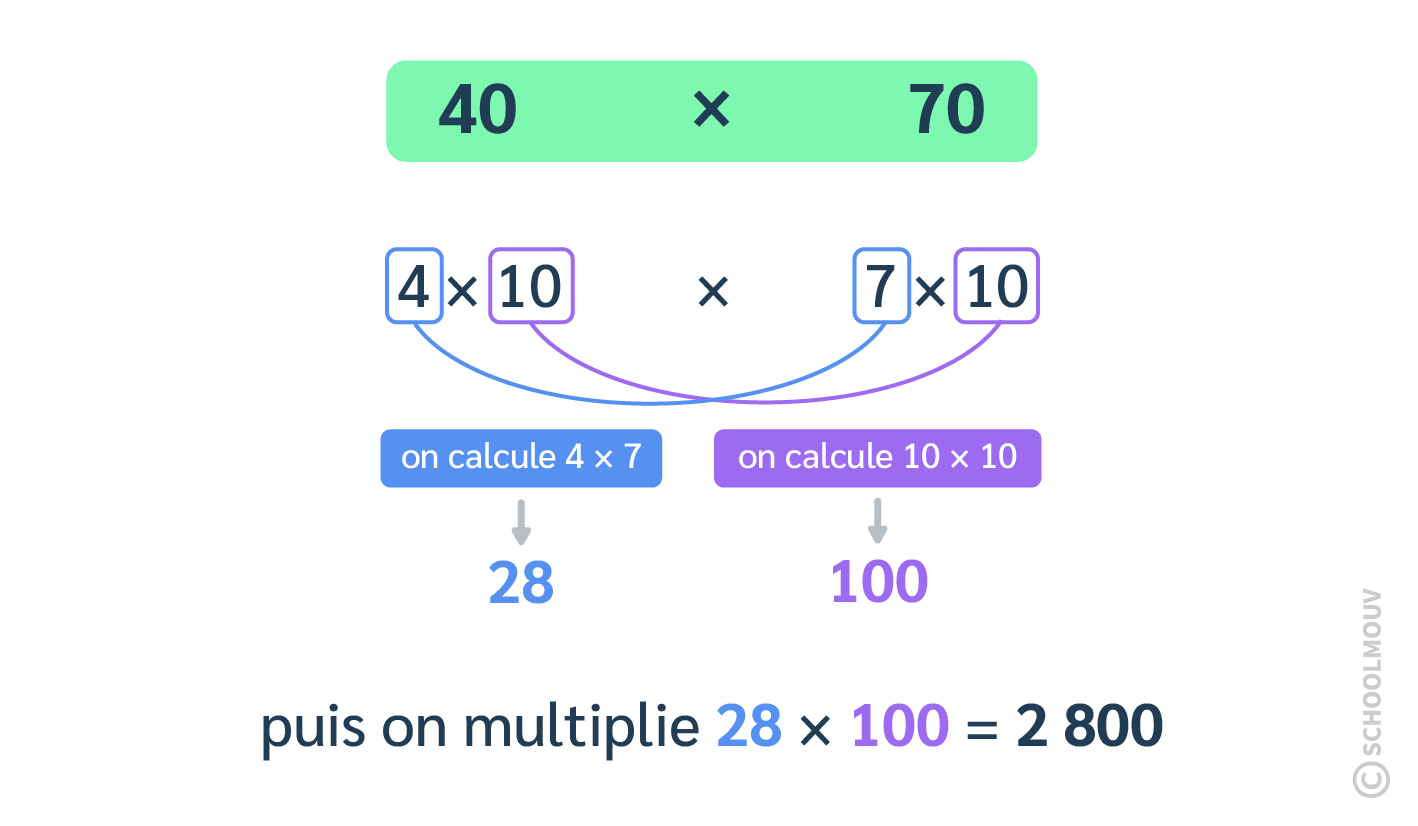
Calculons : $40\times 70$.
On décompose chaque nombre : $$40 = \textcolor{#0086BF}4\times \textcolor{#7151C0}1\textcolor{#7151C0}0 \,\,\, \text{et} \,\,\ 70 = \textcolor{#0086BF}7\times \textcolor{#7151C0}1\textcolor{#7151C0}0$$
On peut donc écrire : $$40\times 70 = (\textcolor{#0086BF}4\times \textcolor{#7151C0}1\textcolor{#7151C0}0)\times(\textcolor{#0086BF}7\times \textcolor{#7151C0}1\textcolor{#7151C0}0)$$
On change l’ordre des facteurs pour regrouper :
- les nombres que l’on peut multiplier grâce aux tables ;
- les nombres 10, 100 ou 1 000.
On obtient : $$40\times 70 = (\textcolor{#0086BF}4\times \textcolor{#0086BF}7)\times(\textcolor{#7151C0}1\textcolor{#7151C0}0\times \textcolor{#7151C0}1\textcolor{#7151C0}0)$$
On calcule : $$\textcolor{#0086BF}4\times \textcolor{#0086BF}7 = \textcolor{#0086BF}2\textcolor{#0086BF}8 \,\,\, \text{et} \,\,\,\textcolor{#7151C0}1\textcolor{#7151C0}0\times \textcolor{#7151C0}1\textcolor{#7151C0}0 = \textcolor{#7151C0}1\textcolor{#7151C0}0\textcolor{#7151C0}0$$
Donc : $$\begin{aligned} 40\times 70 &= \textcolor{#0086BF}2\textcolor{#0086BF}8\times \textcolor{#7151C0}1\textcolor{#7151C0}0\textcolor{#7151C0}0 \\ &= 2\,800 \end{aligned}$$

À retenir
Pour multiplier deux nombres formés de dizaines, de centaines ou de milliers, on peut :
- décomposer chaque facteur ;
- changer l’ordre des facteurs pour regrouper les calculs faciles ;
- utiliser les tables de multiplication ;
- terminer le calcul avec la multiplication par 10, 100, 1 000, etc.
Utiliser la méthode avec des dizaines, des centaines et des milliers
La méthode reste la même avec des nombres plus grands.
Exemple
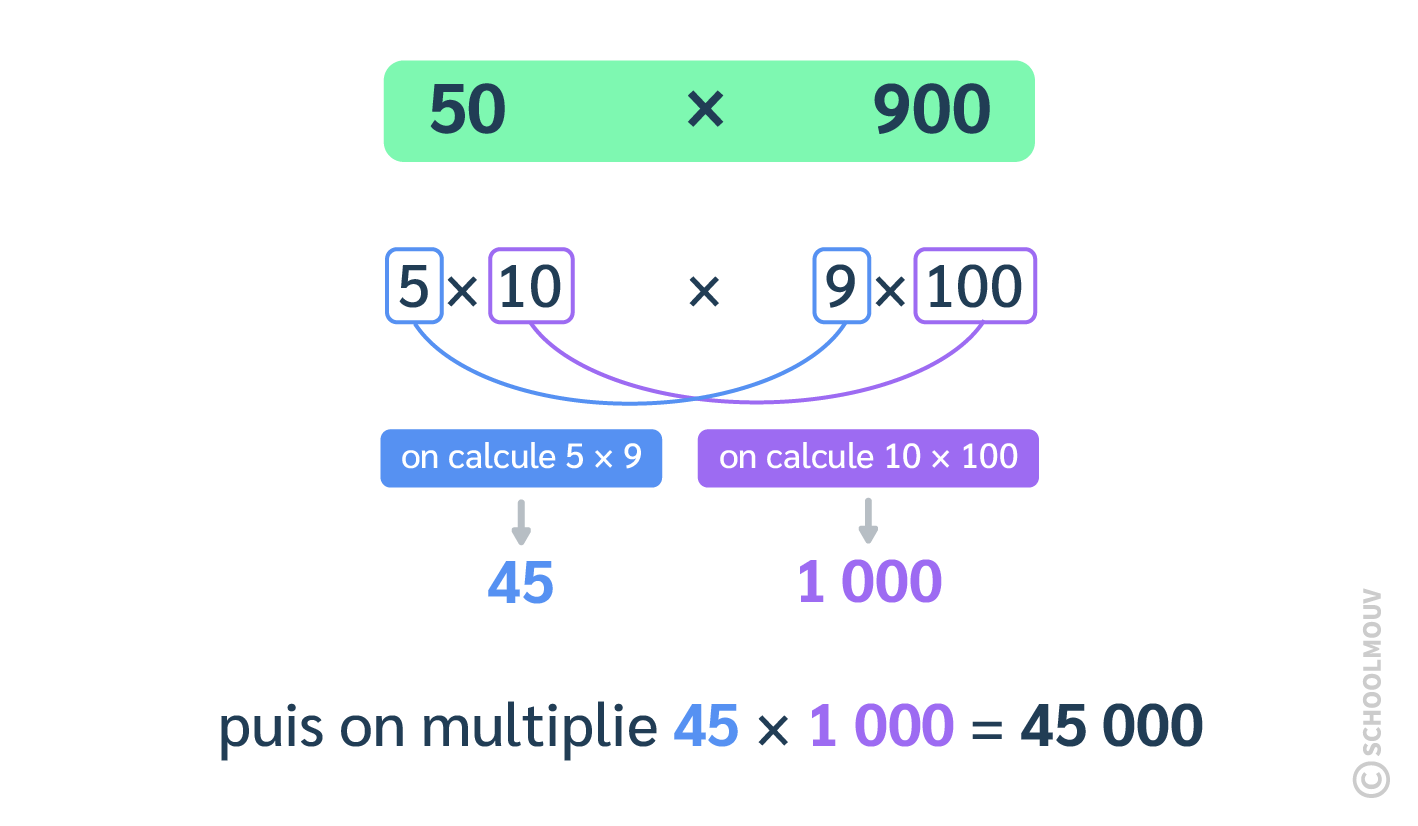
Calculons : $50\times 900$.
On décompose chaque nombre : $$50 = \textcolor{#0086BF}5\times \textcolor{#7151C0}1\textcolor{#7151C0}0 \,\,\, \text{et} \,\,\, 900 = \textcolor{#0086BF}9\times \textcolor{#7151C0}1\textcolor{#7151C0}0\textcolor{#7151C0}0$$
On peut donc écrire : $$50\times 900 = (\textcolor{#0086BF}5\times \textcolor{#7151C0}1\textcolor{#7151C0}0)\times(\textcolor{#0086BF}9\times \textcolor{#7151C0}1\textcolor{#7151C0}0\textcolor{#7151C0}0)$$
On change l’ordre des facteurs : $$50\times 900 = (\textcolor{#0086BF}5\times \textcolor{#0086BF}9)\times(\textcolor{#7151C0}1\textcolor{#7151C0}0\times \textcolor{#7151C0}1\textcolor{#7151C0}0\textcolor{#7151C0}0)$$
On calcule : $$\textcolor{#0086BF}5\times \textcolor{#0086BF}9 = \textcolor{#0086BF}4\textcolor{#0086BF}5 \,\,\, \text{et} \,\,\, \textcolor{#7151C0}1\textcolor{#7151C0}0\times \textcolor{#7151C0}1\textcolor{#7151C0}0\textcolor{#7151C0}0 = \textcolor{#7151C0}1\,\textcolor{#7151C0}0\textcolor{#7151C0}0\textcolor{#7151C0}0$$
Donc : $$\begin{aligned} 50\times 900 &= \textcolor{#0086BF}4\textcolor{#0086BF}5\times \textcolor{#7151C0}1\,\textcolor{#7151C0}0\textcolor{#7151C0}0\textcolor{#7151C0}0 \\ &= 45\,000 \end{aligned}$$
Exemple
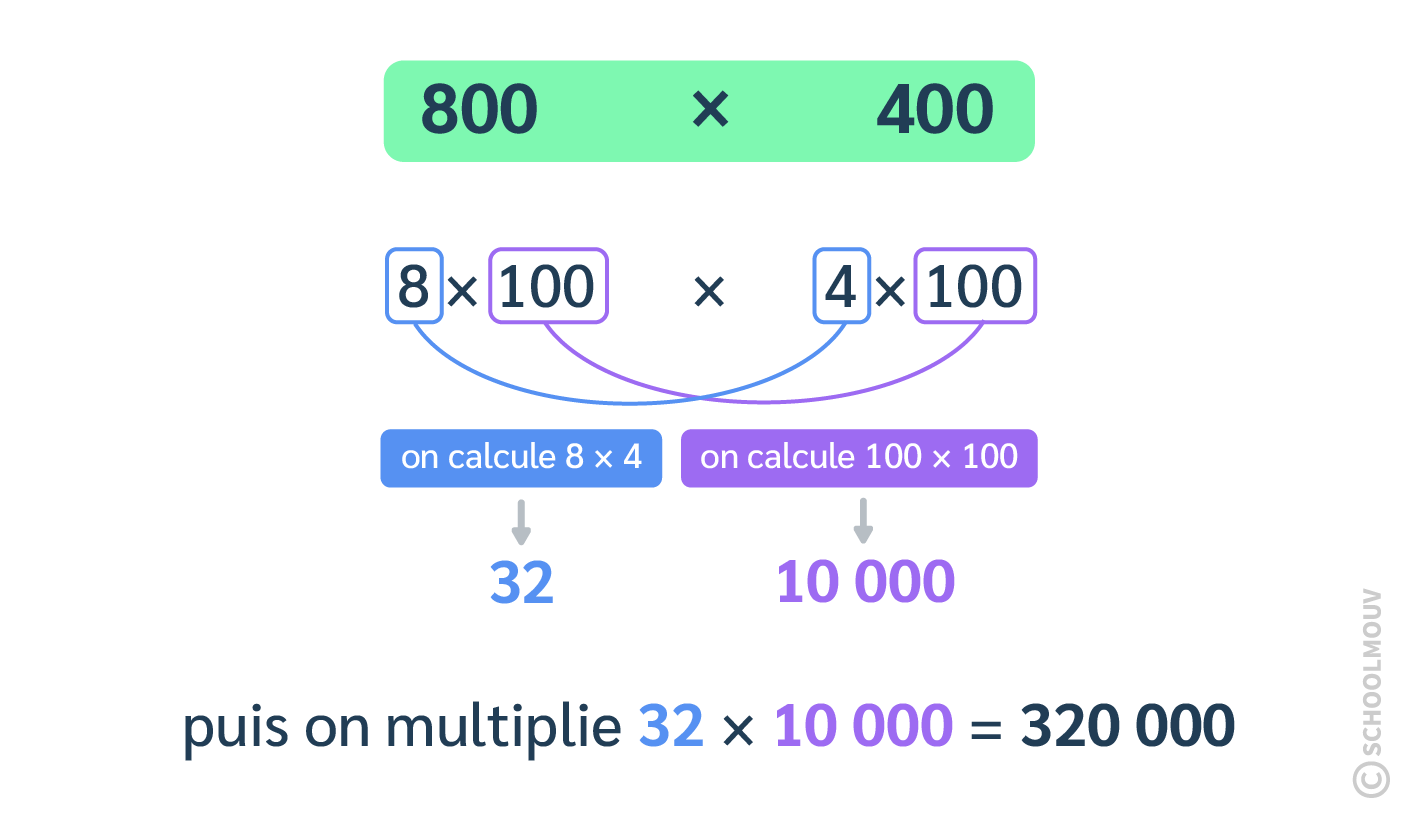
Calculons : $800\times 400$.
On décompose chaque nombre : $$800 = \textcolor{#0086BF}8\times \textcolor{#7151C0}1\textcolor{#7151C0}0\textcolor{#7151C0}0 \,\,\, \text{et} \,\,\, 400 = \textcolor{#0086BF}4\times \textcolor{#7151C0}1\textcolor{#7151C0}0\textcolor{#7151C0}0$$
On peut donc écrire : $$800\times 400 = (\textcolor{#0086BF}8\times \textcolor{#7151C0}1\textcolor{#7151C0}0\textcolor{#7151C0}0)\times(\textcolor{#0086BF}4\times \textcolor{#7151C0}1\textcolor{#7151C0}0\textcolor{#7151C0}0)$$
On change l’ordre des facteurs : $$800\times 400 = (\textcolor{#0086BF}8\times \textcolor{#0086BF}4)\times(\textcolor{#7151C0}1\textcolor{#7151C0}0\textcolor{#7151C0}0\times \textcolor{#7151C0}1\textcolor{#7151C0}0\textcolor{#7151C0}0)$$
On calcule : $$\textcolor{#0086BF}8\times \textcolor{#0086BF}4 = \textcolor{#0086BF}3\textcolor{#0086BF}2 \,\,\, \text{et} \,\,\,\textcolor{#7151C0}1\textcolor{#7151C0}0\textcolor{#7151C0}0\times \textcolor{#7151C0}1\textcolor{#7151C0}0\textcolor{#7151C0}0 = \textcolor{#7151C0}1\textcolor{#7151C0}0\,\textcolor{#7151C0}0\textcolor{#7151C0}0\textcolor{#7151C0}0$$
Donc : $$\begin{aligned} 800\times 400 &= \textcolor{#0086BF}3\textcolor{#0086BF}2\times \textcolor{#7151C0}1\textcolor{#7151C0}0\,\textcolor{#7151C0}0\textcolor{#7151C0}0\textcolor{#7151C0}0 \\ &= 320\,000 \end{aligned}$$
Exemple
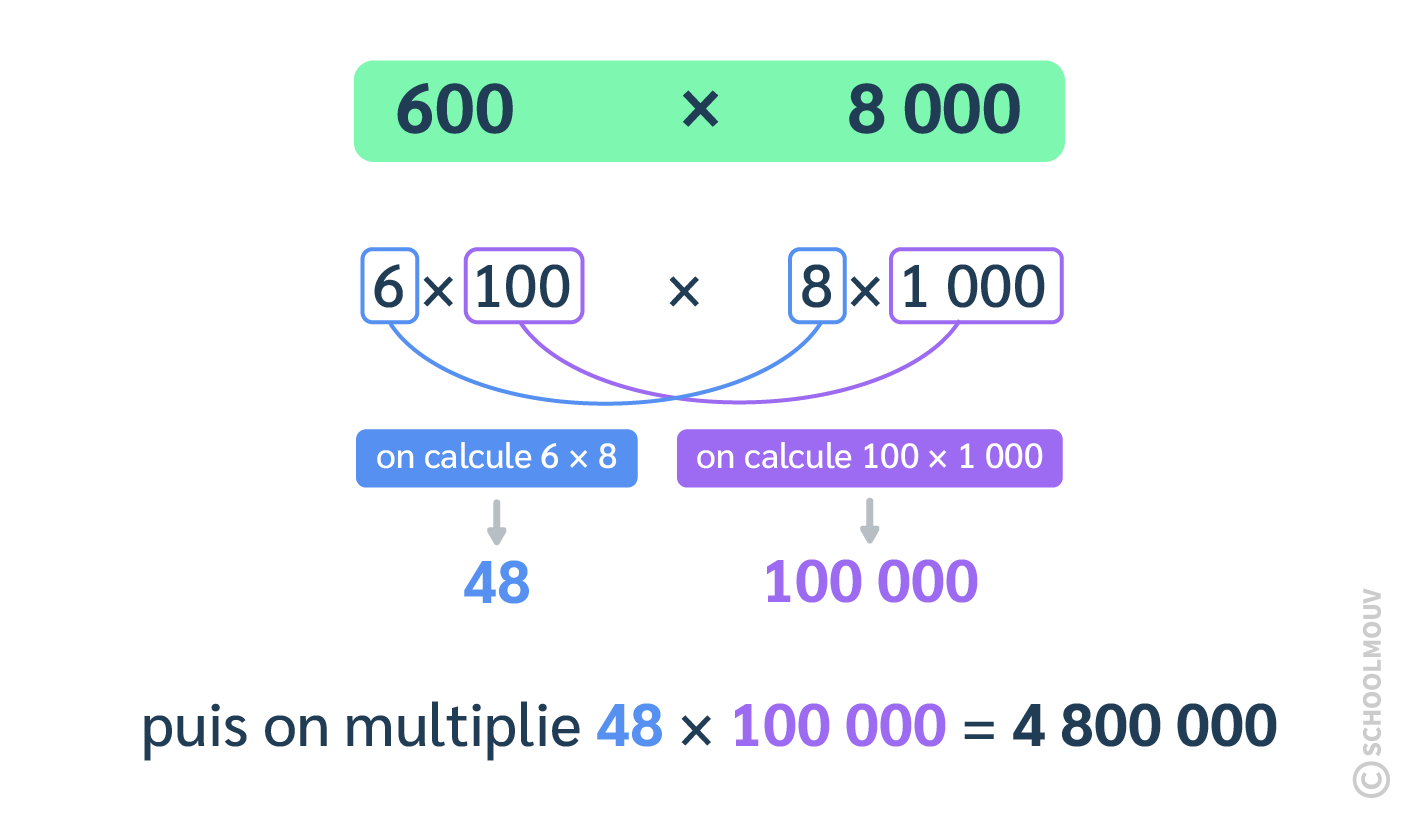
Calculons : $600\times 8\,000$.
On décompose chaque nombre : $$600 = \textcolor{#0086BF}6\times \textcolor{#7151C0}1\textcolor{#7151C0}0\textcolor{#7151C0}0 \,\,\, \text{et} \,\,\, 8\,000 = \textcolor{#0086BF}8\times \textcolor{#7151C0}1\,\textcolor{#7151C0}0\textcolor{#7151C0}0\textcolor{#7151C0}0$$
On peut donc écrire : $$600\times 8\,000 = (\textcolor{#0086BF}6\times \textcolor{#7151C0}1\textcolor{#7151C0}0\textcolor{#7151C0}0)\times(\textcolor{#0086BF}8\times \textcolor{#7151C0}1\,\textcolor{#7151C0}0\textcolor{#7151C0}0\textcolor{#7151C0}0)$$
On change l’ordre des facteurs : $$600\times 8\,000 = (\textcolor{#0086BF}6\times \textcolor{#0086BF}8)\times(\textcolor{#7151C0}1\textcolor{#7151C0}0\textcolor{#7151C0}0\times \textcolor{#7151C0}1\,\textcolor{#7151C0}0\textcolor{#7151C0}0\textcolor{#7151C0}0)$$
On calcule : $$\textcolor{#0086BF}6\times \textcolor{#0086BF}8 = \textcolor{#0086BF}4\textcolor{#0086BF}8 \,\,\, \text{et} \,\,\, \textcolor{#7151C0}1\textcolor{#7151C0}0\textcolor{#7151C0}0\times \textcolor{#7151C0}1\,\textcolor{#7151C0}0\textcolor{#7151C0}0\textcolor{#7151C0}0 = \textcolor{#7151C0}1\textcolor{#7151C0}0\textcolor{#7151C0}0\,\textcolor{#7151C0}0\textcolor{#7151C0}0\textcolor{#7151C0}0$$
Donc : $$\begin{aligned} 600\times 8\,000 &= \textcolor{#0086BF}4\textcolor{#0086BF}8\times \textcolor{#7151C0}1\textcolor{#7151C0}0\textcolor{#7151C0}0\,\textcolor{#7151C0}0\textcolor{#7151C0}0\textcolor{#7151C0}0 \\ &= 4\,800\,000 \end{aligned}$$
Exemple
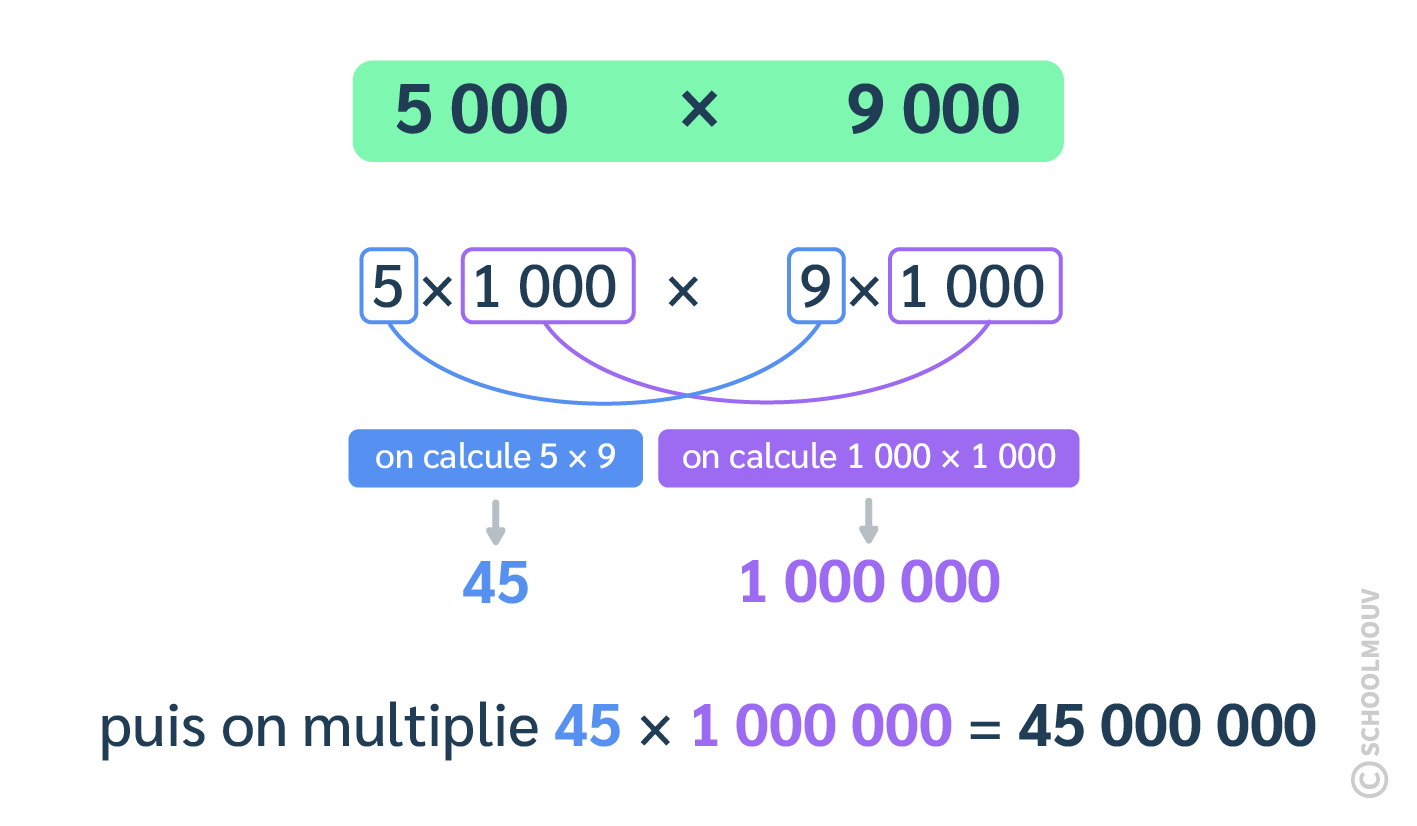
Calculons : $5\,000\times 9\,000$.
On décompose chaque nombre : $$5\,000 = \textcolor{#0086BF}5\times \textcolor{#7151C0}1\,\textcolor{#7151C0}0\textcolor{#7151C0}0\textcolor{#7151C0}0 \,\,\, \text{et} \,\,\,9\,000 = \textcolor{#0086BF}9\times \textcolor{#7151C0}1\,\textcolor{#7151C0}0\textcolor{#7151C0}0\textcolor{#7151C0}0$$
On peut donc écrire : $$5\,000\times 9\,000 = (\textcolor{#0086BF}5\times \textcolor{#7151C0}1\,\textcolor{#7151C0}0\textcolor{#7151C0}0\textcolor{#7151C0}0)\times(\textcolor{#0086BF}9\times \textcolor{#7151C0}1\,\textcolor{#7151C0}0\textcolor{#7151C0}0\textcolor{#7151C0}0)$$
On change l’ordre des facteurs : $$5\,000\times 9\,000 = (\textcolor{#0086BF}5\times \textcolor{#0086BF}9)\times(\textcolor{#7151C0}1\,\textcolor{#7151C0}0\textcolor{#7151C0}0\textcolor{#7151C0}0\times \textcolor{#7151C0}1\,\textcolor{#7151C0}0\textcolor{#7151C0}0\textcolor{#7151C0}0)$$
On calcule : $$\textcolor{#0086BF}5\times \textcolor{#0086BF}9 = \textcolor{#0086BF}4\textcolor{#0086BF}5 \,\,\, \text{et} \,\,\, \textcolor{#7151C0}1\,\textcolor{#7151C0}0\textcolor{#7151C0}0\textcolor{#7151C0}0\times \textcolor{#7151C0}1\,\textcolor{#7151C0}0\textcolor{#7151C0}0\textcolor{#7151C0}0 = \textcolor{#7151C0}1\,\textcolor{#7151C0}0\textcolor{#7151C0}0\textcolor{#7151C0}0\,\textcolor{#7151C0}0\textcolor{#7151C0}0\textcolor{#7151C0}0$$
Donc : $$\begin{aligned} 5\,000\times 9\,000 &= \textcolor{#0086BF}4\textcolor{#0086BF}5\times \textcolor{#7151C0}1\,\textcolor{#7151C0}0\textcolor{#7151C0}0\textcolor{#7151C0}0\,\textcolor{#7151C0}0\textcolor{#7151C0}0\textcolor{#7151C0}0 \\ &= 45\,000\,000 \end{aligned}$$